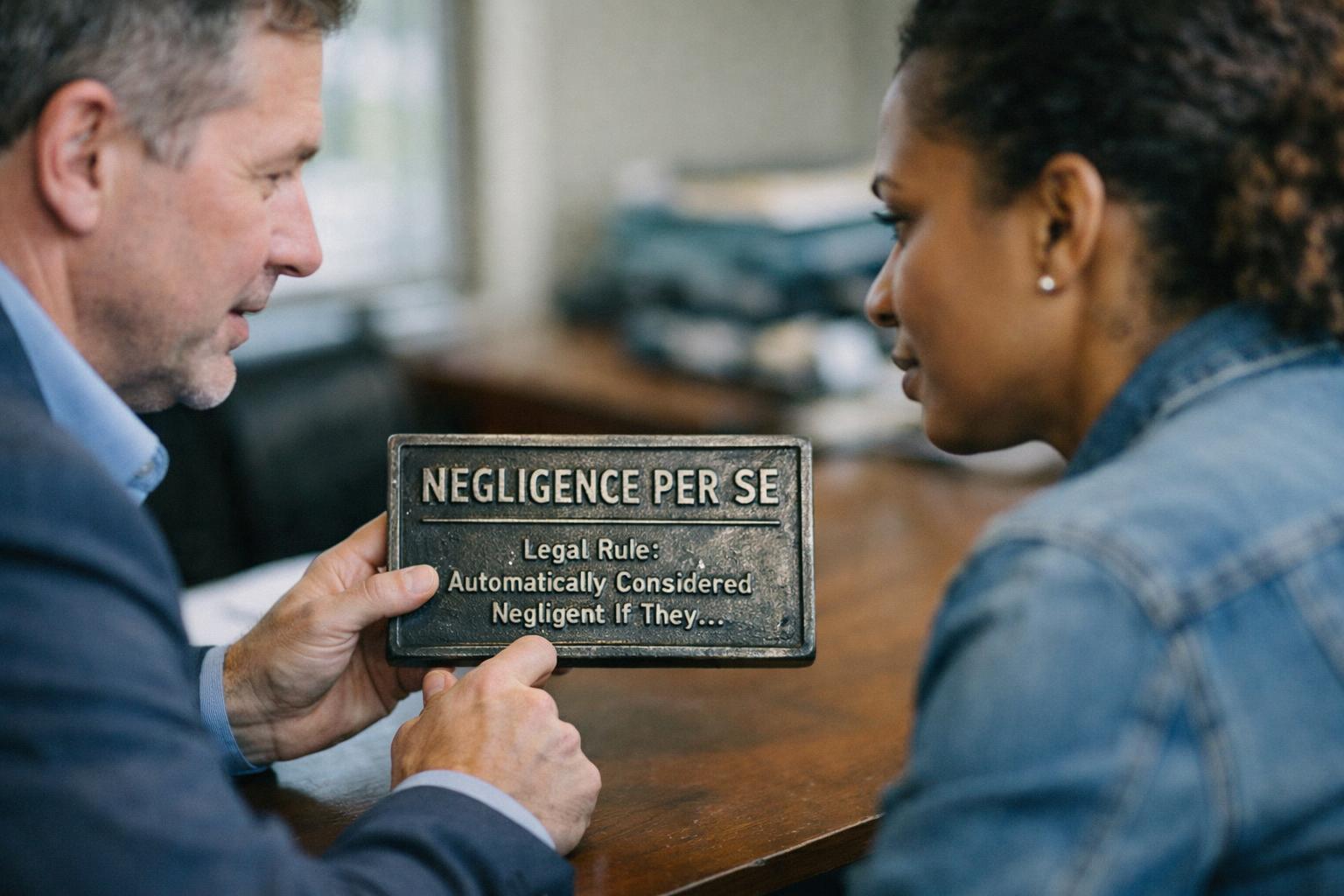
Negligence Per Se is a legal rule that automatically considers someone negligent if they violate a safety law or regulation and that violation directly causes an injury. Instead of proving carelessness, the injured person only needs to show the law was broken and the harm resulted from that breach.
Category
Legal doctrine in personal injury law
Used for
Proving fault in injury cases involving law violations
Common confusion
Ordinary negligence requires proving carelessness; Negligence Per Se does not
Also called
Per Se Negligence
Often discussed with
Car Accident Lawyer, Pedestrian Accident Lawyer

Negligence Per Se makes it easier to prove fault in injury cases. Normally, an injured person must show the defendant was careless. They must also show the defendant didn’t meet a standard of care.
Related glossary terms: Comparative Negligence, Gross Negligence, Res Ipsa Loquitur.
With Negligence Per Se, the focus changes. It looks at whether the defendant broke a safety law. If the violation caused the injury, the defendant is negligent by default. No extra proof of carelessness is needed.
This rule only applies to laws that prevent the harm that happened. For example, speeding laws exist to stop accidents. Breaking one and causing a crash could trigger Negligence Per Se.
But breaking a law not about safety won’t qualify. Failing to file taxes is an example. The injured person must still link the violation to their injury. But the proof needed is lighter than in a normal case.
To prove Negligence Per Se, three things must be shown. First, the defendant broke a law or rule. This could be a traffic law, building code. Or safety rule.
Second, the law must protect a specific group from harm. A law requiring handrails on stairs protects people from falls. Breaking it could lead to Negligence Per Se if someone gets hurt.
Third, the violation must have caused the injury directly. Courts check if the law’s purpose matches the harm. If a driver runs a red light and hits someone, the violation relates to the injury.
But if the driver had an expired license but drove safely, it might not count. The expired license didn’t cause the crash. The rule isn’t about punishing lawbreakers. It’s about holding them accountable when their actions cause harm.

Negligence Per Se helps injured people get compensation faster. Proving negligence can be hard and take a lot of time. It often needs experts or lots of evidence.
This rule removes some of that burden. It uses existing laws to make things easier. Victims can hold wrongdoers accountable without as much hassle. It also shows why following safety laws is so important.
For defendants, this rule can limit their defenses. If they broke a safety law and caused harm, they may be negligent. Even if they took other precautions, it might not matter. This shows why following rules is key.
Even small violations can lead to big trouble in injury cases.
Negligence Per Se matters most when a safety law is broken. That violation must lead to an injury. Common cases include car accidents from traffic violations.
Unsafe property conditions can also count. This happens when building codes are ignored. Workplace accidents from missed safety rules fit too. For example, a driver texting while driving breaks the law.
If they cause a crash, Negligence Per Se may apply. A landlord ignoring smoke detector rules could face it too. If a tenant is hurt in a fire, the landlord may be liable.
This rule helps when proving negligence is tough. If there’s no direct evidence of carelessness, it offers another path. It focuses on the broken safety law instead. But it doesn’t apply in every case.
It only works when the law is meant to stop the harm that happened. Knowing when it applies helps injured people and lawyers. It lets them build stronger cases.

Ordinary negligence requires proving the defendant acted carelessly. While Negligence Per Se relies on a law violation to establish fault.
Gross negligence involves extreme recklessness. While Negligence Per Se focuses on breaking a safety law, regardless of intent.
Res Ipsa Loquitur means 'the thing speaks for itself' and applies when an injury suggests negligence. While Negligence Per Se requires a specific law violation.
Negligence Per Se shifts the focus from proving carelessness to proving a law violation caused harm. However, not all violations qualify—only those tied to the injury’s prevention. Georgia courts carefully review the law’s intent and the harm’s connection to the violation.
A driver in Decatur, GA, speeds through a school zone, violating Georgia’s reduced speed limit law. The driver hits a child crossing the street, causing serious injuries. Because the speeding law exists to protect children in school zones, the driver could be found negligent per se, making it easier for the child’s family to seek compensation for medical bills and pain and suffering.
Comparative Negligence is a legal rule used in personal injury cases to determine how much fault each party shares when an accident occurs. Under this rule, a person who is partly at fault for their own injuries can still recover damages. But the amount is reduced by their percentage of fault. This system aims to allocate responsibility fairly between all involved parties.
Gross Negligence is a legal term describing an extreme lack of care that shows reckless disregard for the safety or lives of others. Unlike ordinary negligence, gross negligence involves actions or omissions so severe they demonstrate a conscious indifference to consequences, often leading to more serious legal penalties or punitive damages.
Res Ipsa Loquitur is a legal doctrine that allows a judge or jury to infer negligence from the mere fact that an accident occurred, even without direct evidence. It applies when the accident would not normally happen without someone’s carelessness, the defendant controlled the instrument causing harm. And the plaintiff did not contribute to the injury.
Tort is a legal term describing a wrongful act or injury that causes harm to another person, leading to legal liability for the person who commits the act. Torts include negligence, intentional harm. And strict liability, allowing injured parties to seek compensation through civil lawsuits rather than criminal charges.
Premises Liability is a legal concept that holds property owners and occupiers responsible for injuries occurring on their property due to unsafe conditions. It requires proving the owner knew or should have known about the hazard and failed to address it, leading to harm. This area of law covers accidents like slips, trips, falls. Or inadequate security.
PersonalInjuryLawyerDecatur.com
Contact PersonalInjuryLawyerDecatur.com for practical guidance on Negligence Per Se and related personal injury lawyer work in Decatur.