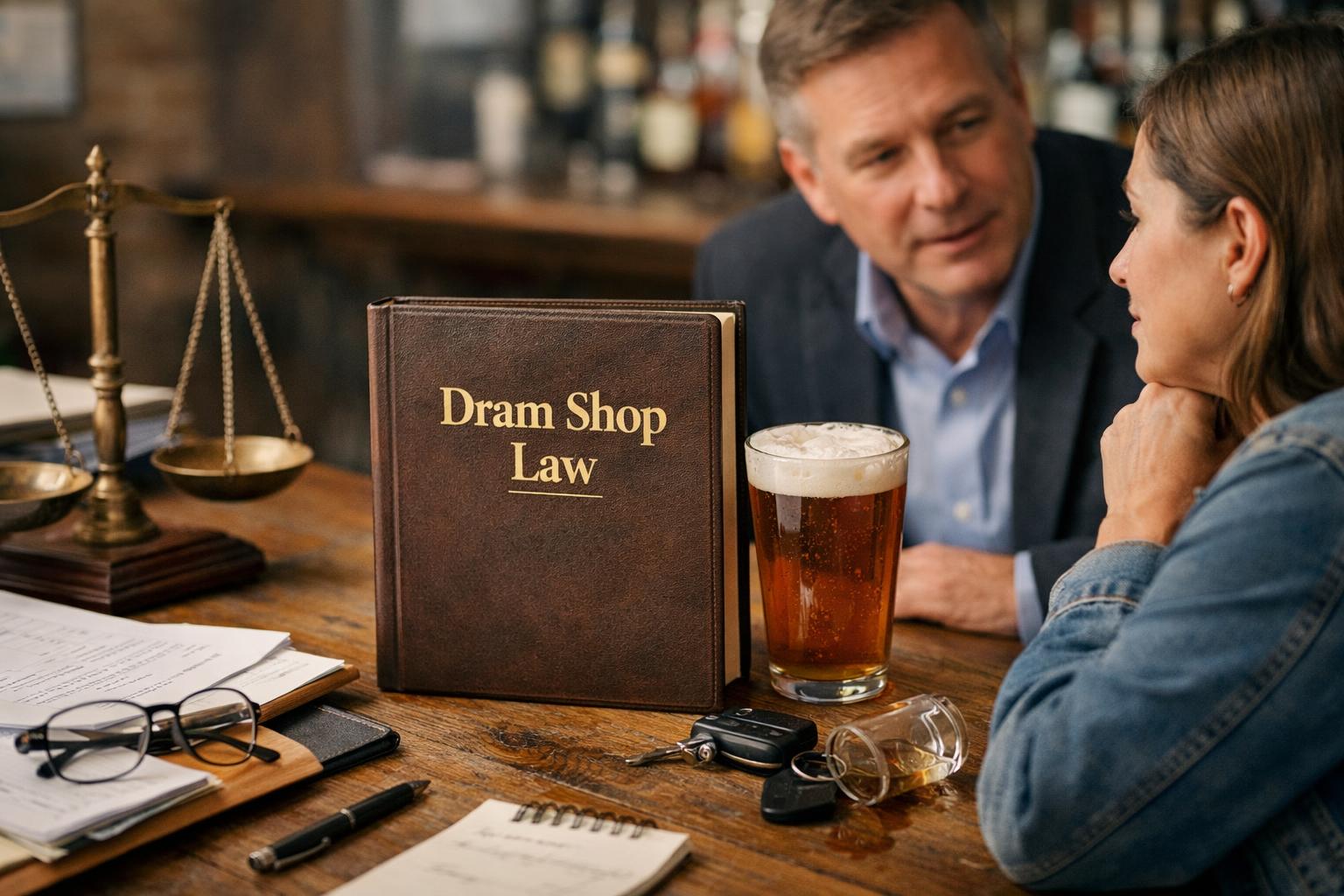
Dram Shop Law is a legal rule that holds bars, restaurants. And other alcohol sellers responsible if they serve alcohol to someone who is visibly intoxicated or underage. And that person later causes injury or harm to others, such as in a drunk driving accident. These laws aim to reduce alcohol-related injuries by encouraging responsible alcohol service.
Category
Civil liability law
Used for
Compensation for alcohol-related injuries
Common confusion
Only applies to commercial sellers, not social hosts
Also called
Dram Shop Act, Alcohol Server Liability Law
Often discussed with
Drunk Driving Accident Lawyer, Wrongful Death Attorney

Dram Shop Law is a legal principle that allows injured parties to hold alcohol sellers accountable for damages caused by their intoxicated patrons. The term "dram shop" dates back to 18th-century England, where alcohol was sold by the dram—a small unit of liquid. Today, these laws apply to bars, restaurants, liquor stores. And other businesses that serve or sell alcohol. The core idea is that if a business knowingly serves alcohol to someone who is already drunk or underage. And that person later causes harm, the business shares some responsibility for the consequences.
Related glossary terms: Negligence Per Se, Vicarious Liability, Tort Law.
These laws are designed to encourage responsible alcohol service and reduce the number of alcohol-related injuries, such as drunk driving accidents or alcohol-fueled violence. Without Dram Shop Laws, victims might only be able to sue the intoxicated person, who may not have enough money or insurance to cover the damages. By including alcohol sellers in the legal equation, these laws provide an additional avenue for victims to seek compensation for medical bills, lost wages, pain and suffering. And other losses.
Dram Shop Law operates on the principle of negligence. To succeed in a Dram Shop claim, the injured party must prove several key elements. First, they must show that the alcohol seller served alcohol to the person who caused the injury. Second, they must demonstrate that the person was either visibly intoxicated or under the legal drinking age at the time they were served. Visible intoxication might include slurred speech, stumbling, aggressive behavior. Or other clear signs of impairment. Third, the injured party must prove that the intoxication directly caused the harm, such as a car accident or assault.
The specifics of Dram Shop Law vary from state to state. Some states have strict laws that hold alcohol sellers liable even if the patron did not appear drunk at the time of service. Others have more limited laws that only apply in specific situations, such as serving minors. In Georgia, for example, Dram Shop Law allows victims to sue alcohol sellers if they served alcohol to a visibly intoxicated person who later caused injury. Or if they served alcohol to someone under 21 who later caused harm. But Georgia’s law doesn't apply to social hosts who provide alcohol in private settings.
Proving a Dram Shop claim often requires evidence such as witness statements, surveillance footage, receipts. Or expert testimony. For instance, a bartender’s testimony or video from the bar might show that the patron was slurring their words or having trouble standing before being served more alcohol. Blood alcohol concentration (BAC) tests from the time of the accident can also help establish the patron’s level of intoxication. Because these cases can be complex, they often involve legal and medical experts who can interpret the evidence and explain how it supports the claim.

Dram Shop Law matters because it provides an important layer of protection for victims of alcohol-related injuries. Drunk driving accidents, for example, often result in serious or fatal injuries. While the intoxicated driver may face criminal charges, criminal cases don't compensate victims for their losses. Civil lawsuits, including Dram Shop claims, allow victims to seek financial recovery for medical expenses, rehabilitation costs, lost income. And other damages. By holding alcohol sellers accountable, these laws also create a financial incentive for businesses to train their staff to recognize signs of intoxication and refuse service when necessary.
Beyond individual cases, Dram Shop Laws play a broader role in public safety. Studies have shown that states with strong Dram Shop Laws tend to have lower rates of alcohol-related accidents and fatalities. This is because businesses are more likely to put in place responsible serving practices when they know they could be held liable for over-serving patrons. For example, bartenders may be more cautious about serving customers who appear drunk. And managers may enforce policies that limit the number of drinks a patron can order. Over time, these practices can help reduce the number of alcohol-related injuries and deaths in the community.
Dram Shop Law becomes especially important in situations where the intoxicated person lacks sufficient insurance or assets to cover the damages they caused. For example, if a drunk driver causes a car accident but only carries the minimum required auto insurance, their policy may not be enough to cover the victim’s medical bills or lost wages. In such cases, a Dram Shop claim against the bar or restaurant that served the driver can provide additional compensation for the victim. This is particularly valuable in cases involving catastrophic injuries, such as traumatic brain injuries or spinal cord damage, where the victim’s medical and care needs may last a lifetime.
Dram Shop Law also matters in cases involving underage drinking. Minors are more likely to engage in risky behaviors, such as drunk driving. And are less experienced with alcohol’s effects. If a business serves alcohol to a minor who later causes harm, the business can be held liable under Dram Shop Law. This creates a strong incentive for alcohol sellers to verify IDs and refuse service to underage patrons. And Dram Shop claims may arise in cases of alcohol-related violence, such as fights or assaults, where the intoxicated person’s actions led to someone else’s injury.
For victims and their families, Dram Shop Law can make the difference between financial ruin and recovery. Medical bills, rehabilitation costs. And lost income can quickly add up after a serious injury. Without the option to pursue a Dram Shop claim, victims might struggle to cover these expenses, especially if the intoxicated person lacks the resources to pay. By providing an additional avenue for compensation, Dram Shop Law helps ensure that victims have a better chance of receiving the financial support they need to rebuild their lives.
Social Host Liability applies to private individuals who serve alcohol at gatherings. While Dram Shop Law applies to commercial sellers like bars and restaurants. Some states treat them separately.
Negligence Per Se involves violating a law, such as serving alcohol to a minor, which automatically establishes negligence. Dram Shop Law often requires proving visible intoxication or intent to over-serve.
Dram Shop claims often hinge on subtle details, such as whether the patron appeared intoxicated at the time of service. Surveillance footage and witness testimony can be critical. But these cases require careful legal strategy to overcome defenses like contributory negligence.
A bar serves multiple drinks to a patron who is slurring their words and having trouble standing. Later, the patron drives home and causes a collision, seriously injuring another driver. Under Dram Shop Law, the injured driver can sue the bar for over-serving the intoxicated patron, in addition to suing the driver.
Negligence Per Se is a legal rule that automatically proves negligence if someone violates a safety law and that violation causes harm. Instead of proving carelessness, the injured person only needs to show the law was broken, the law was meant to prevent the type of harm suffered.
Vicarious Liability is a legal principle that holds one person or entity legally responsible for the actions of another, even without direct fault. This often applies in employer-employee relationships, where an employer may be liable for an employee’s negligent actions performed within the scope of their job. It also extends to vehicle owners and parents in certain situations.
Tort Law is a branch of civil law that allows individuals to seek compensation when they suffer harm or loss due to another party’s wrongful actions or negligence. It covers injuries, property damage. And other losses caused by accidents, intentional acts. Or failures to act responsibly. The goal is to restore the injured party to their pre-harm condition, often through financial damages.
Comparative Negligence is a legal principle used in personal injury cases to determine how fault is shared between parties involved in an accident. It allows a damaged party to recover compensation even if they are partially at fault, with their recovery reduced by their percentage of responsibility. This rule contrasts with contributory negligence, which bars recovery if any fault is assigned to the injured party.
Catastrophic Injury is a severe physical harm that permanently alters a person’s ability to perform daily activities, work. Or live independently. These injuries often result from sudden trauma, such as car accidents, falls. Or violence. And typically involve the brain, spinal cord, limbs. Or internal organs. Recovery may require lifelong medical care, rehabilitation. And assistive devices.
Atlanta Auto Law
Contact Atlanta Auto Law for practical guidance on Dram Shop Law and related personal injury lawyer work in Decatur.